 QUANTUM OPTIMA
Optimal decisions
under uncertainty.
We build optimisation and decision-assurance software for energy and defence—turning complex constraints into clear, explainable actions.
Classical optimisation today. Quantum-enhanced methods in development.
The best use of scarce resources, with reasons given.
Built for incomplete, noisy and fast-changing inputs.
One formulation that runs on classical and quantum solvers.
Energy markets and counter-UAS defence.
Both put a decision-maker in the same position: scarce resources, competing demands, and estimates that may be wrong. The same engine serves both.
See the market. Run the battery. Judge the investment.
Quantum Energy Intelligence →
Live and historical electricity-market data: 150+ measures, more than five years of history.
Quantum Energy Optimisation →
Battery dispatch across day-ahead, intraday and balancing markets. TRL 7, in a paid pilot.
IBAP: Independent BESS Assessment and Planning →
What a battery can earn and how it should be built, for investors, lenders and developers.
Classical energy optimiser
EnergyMarket measures, more than 5 years of history
Quantum Energy IntelligenceCritical-site hits per raid against a simple rule, in synthetic studies
Aegis · 36 studiesThreat-to-effector decision time
Aegis · TRL 4From formulation to real quantum hardware.
We write our decision problems in the form quantum computers accept, run them on real devices, and compare every result with the best classical answer. We publish what we find, including where quantum does not yet win.
- 01 · Formulate
QUBO and Ising
The assignment problem written as an energy landscape whose lowest point is the best decision.
- 02 · Reference
Exact classical answer
Every instance is solved exactly first, so each quantum result has a ground truth to be judged against.
- 03 · Run
QAOA on IBM Quantum
A 3×3 allocation case compiled and executed on a real IBM quantum processor, ibm_kingston.
- 04 · Compare
Annealing baseline
The same case solved with D-Wave's open-source simulated annealer, run locally as a classical benchmark.
- 05 · Report
Frozen and versioned
Each experiment is fixed before results are seen and versioned in the Quantum Optima Benchmark Suite.
BESS Monthly No. 1 and a new white paper, optimal battery decisions under uncertainty.
Optima Aegis presented at ELKAK Innovation Days.
Quantum Optima joins Elevate Greece.
Contributed to the Swedish FMV dialogue on future naval command and control.
Optima Aegis pitched at the Counter-UAS Forum in Berlin.
Quantum Energy Intelligence goes live at curves.quant-optima.com.
A decision you cannot afford to get wrong?
Tell us what has to be decided, and how fast.
Uncertainty is the input. A decision is the output.
We treat every problem as an allocation under uncertainty. We formulate it once, solve it with the best available method, and explain the result to the person who has to act on it.
Scenarios, not single forecasts
Prices, threat behaviour and sensor quality enter as distributions and scenarios, so the decision holds up when an estimate is wrong.
Optimal within the time available
Exact methods where they are fast enough, and bounded approximations where they are not. A good answer delivered on time beats a perfect one delivered late.
Explainable by default
Every recommendation states its confidence, the constraints it met and the cost of waiting.
Data
Market curves, asset telemetry, sensor tracks.
LiveFormulation
Assignment and b-matching models, with QUBO and Ising forms of the same problem.
Shared coreClassical solvers
MILP and the Hungarian method. Provably optimal allocations in milliseconds.
TRL 7 · in pilotQuantum layer
QAOA on IBM Quantum and annealing on D-Wave, benchmarked against the classical result.
ResearchDecision layer
Recommendation, confidence and trade-offs, approved by a person.
ExplainableWe report where quantum does not yet win.
Each experiment in the Quantum Optima Benchmark Suite is versioned and run against the classical solver on the same problem and time budget. When the classical solver wins, we report that too. Clients get classical results now and a clear path to quantum if and when it pays off.
The market, measured before it is decided.
Quantum Energy Intelligence is our live market-data platform. It shows price curves, spreads, load, renewable output and balancing signals, live and historical, and it is the data layer under Quantum Energy Optimisation and IBAP.
Market measures tracked
CoverageOf historical data for backtests and scenarios
HistoryAt curves.quant-optima.com since June 2026
PlatformGreek day-ahead, intraday and balancing markets
MarketsPrices and spreads
Day-ahead and intraday price curves, spreads and volatility, the inputs to every dispatch and revenue decision.
System signals
Load, renewable output and balancing signals, so a decision reflects the state of the system, not only the price.
History for scenarios
More than five years of history to build the price and activation scenarios that Quantum Energy Optimisation and IBAP use.
Quantum Energy Intelligence
Measures the market: prices, spreads, system signals and their history.
Quantum Energy Optimisation
Uses that data to decide where each megawatt-hour goes, every day.
IBAP
Uses the same data and models to assess what a battery can earn and plan how to build it.
Dispatch decisions for batteries in volatile markets.
A battery can sell into several markets every hour, and prices change between the time a bid goes in and the time it clears. Quantum Energy Optimisation decides where each megawatt-hour goes, within the asset's physical limits. It runs on classical optimisation today; quantum-enhanced methods are in development.
Classical optimiser, validated in an operational environment.
TechnologyPaid pilot with a Greek energy aggregator, under a signed letter of intent.
CommercialMember of the GreenSyn Accelerator in Cyprus.
AcceleratorMarket measures feeding the optimiser.
DataBESS dispatch
Day-ahead, intraday and balancing bids for standalone batteries. The optimiser respects state of charge, cycling limits and grid constraints, and re-plans as prices move.
Co-located BESS
Joint dispatch of a battery with solar on the same connection point, so curtailment and storage are decided together. Read more →
Fleet optimisation
Portfolio-level decisions across several batteries and virtual power plants. Read more →
Built on Quantum Energy Intelligence
Every decision draws on our live market data: price curves, spreads and system signals, with five years of history behind the scenarios. About the data →
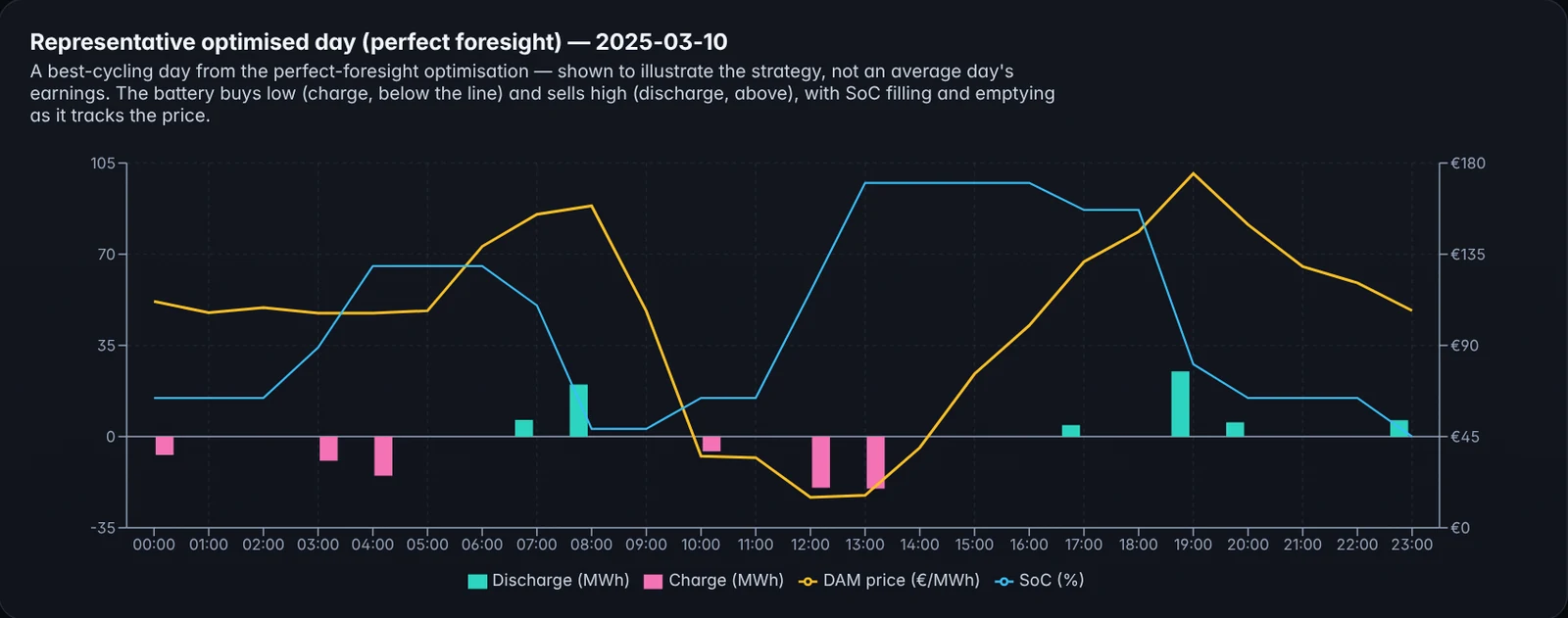
Buy low, sell high, within the limits.
One optimised day for an example 25 MW / 50 MWh battery on Greek day-ahead prices: charging in the cheap midday hours, discharging into the morning and evening peaks, with the state of charge tracking every move.
Transparent by design.
Visible constraints
Every rule the optimiser respects is written down and can be inspected. No black box.
Physics-aware
State of charge, efficiency, cycling limits and degradation are modelled explicitly, not approximated.
Portfolio-native
One battery or a whole fleet, with revenue aggregated across assets and markets.
Revenue you can audit
Every figure, from €/kW-year to cycles and state of charge, comes straight from the solver results.
Local or cloud
Runs on your servers or ours, as a modular system that fits your existing workflow.
Simple commercial terms
A transparent subscription, with an optional revenue-share model.
From your data to live dispatch.
Backtest
We run the optimiser on your asset's history and compare it with what the asset earned.
Paid pilot
Live recommendations next to your current process, measured against agreed metrics.
Production
Integration into your bidding workflow, with reports your risk team can audit.
See what your battery could have earned.
Send a year of dispatch data and we return a backtest.
What a battery can really earn, and how it should be built.
Revenue projections for storage projects usually come from the people selling them. IBAP gives investors, lenders and developers a separate, model-based view of revenue, risk, bankability and design before money is committed.
For investors and lenders
The question
Is this revenue case credible, and will it support debt in a bad month?
What you receive
Revenue ranges by market, monthly cash flow, DSCR under base and downside cases, and an optional benchmark of the optimiser's results, online in IBAP and as a PDF report.
For developers and owners
The question
What should we build: how many MW, how many hours, standalone or co-located?
What you receive
Revenue as a function of power, duration and co-location category, with the trade-offs between them.
Assessment and planning are always separate engagements. When we plan a project for its developer, we do not provide the independent assessment of that same project to its lender.
What an assessment shows.
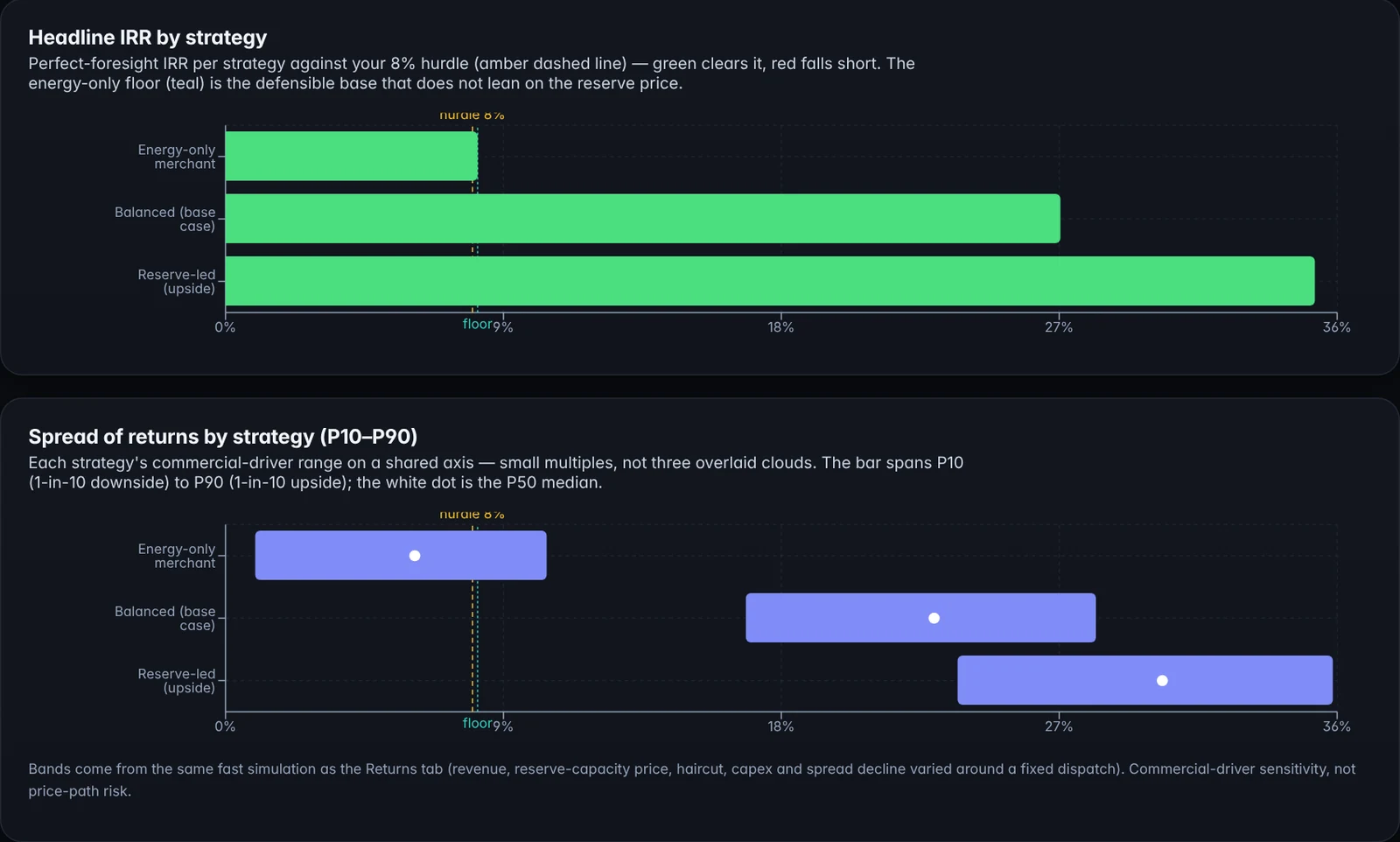
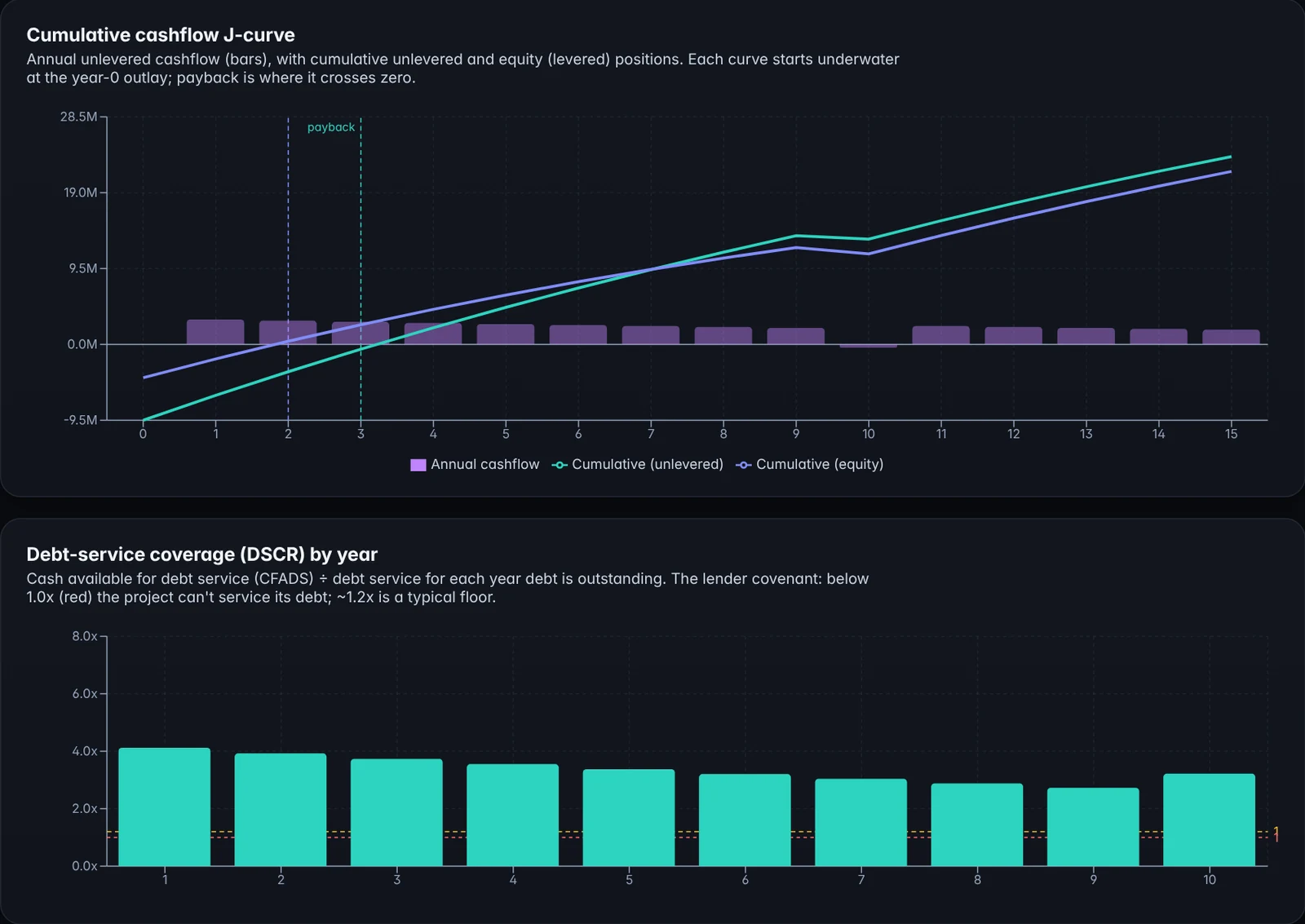
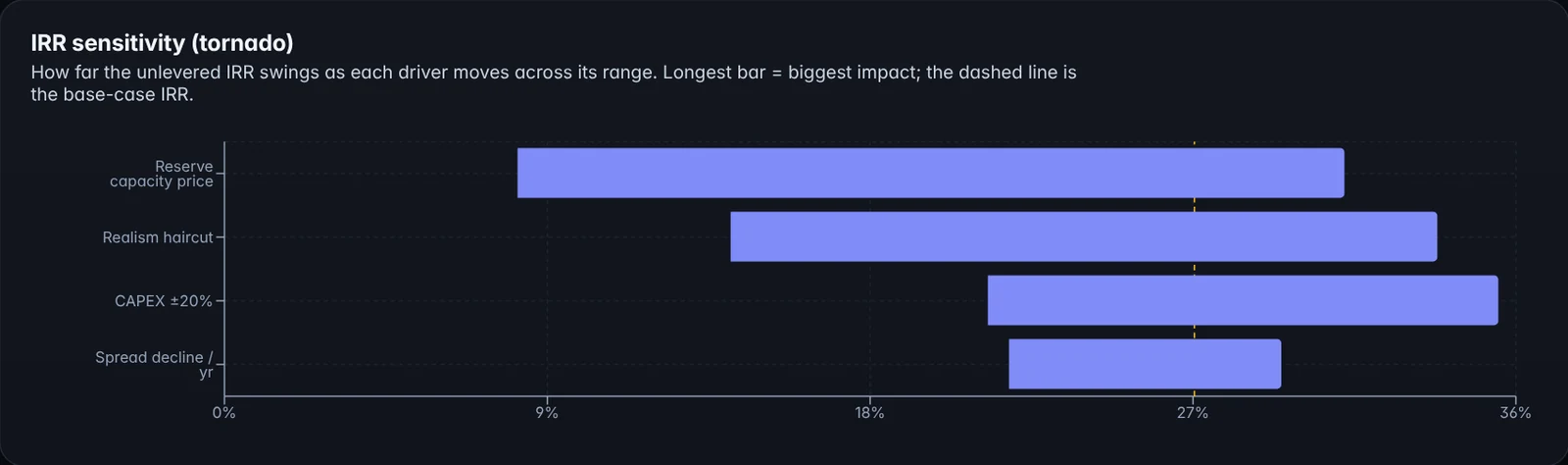
Screens from IBAP, where we build and deliver every assessment, here for an example standalone battery (25 MW / 50 MWh) on 2025 Greek day-ahead data. The returns shown are perfect-foresight ceilings on illustrative inputs, not a forecast for any real project.
Five tests for a credible revenue case.
Market-realistic, physically deliverable, contractually compliant, financially bankable and operationally adaptive. A case passes IBAP only if it holds up under all five. Read the method →
Revenue
Expected earnings across day-ahead, intraday and balancing markets, with the optimal mix for each period.
Risk
Revenue ranges under price, volatility and market-design scenarios, so the downside is visible to the lender.
Design
How revenue changes with MW, MWh, duration and co-location, to set the right asset before it is built.
Evaluating or planning a storage project?
Tell us which, and we will scope an IBAP engagement.
The work behind our numbers.
Our market brief, white paper, benchmark method and glossary, published so that investors, lenders and evaluators can check how we reach our conclusions.
BESS Monthly New
Our monthly brief on what changes battery revenue. No. 1, November 2026: Greece passes 1 GW, and access starts to matter more than spread.
Read the issue →White paper: optimal battery decisions under uncertainty
The decision problem, where uncertainty enters in Greece today, how we optimise and assess under it, and where quantum methods honestly stand.
White paper →Classical and quantum: how we benchmark
Our method for testing quantum solvers against exact classical answers, and where the results stand.
Benchmark →Co-located BESS
Deciding curtailment and dispatch together under Greece's 11A, 11B and 11C rules.
Read →Fleet optimisation
Dispatching many batteries as one portfolio within site, network and regulatory limits.
Read →BESS Monthly archive
August 2026, published as BESS Weekly: bankability, market design and the new economics of flexibility.
Archive → Optima AegisDual-use · Counter-UAS · TRL 4
The right effector for each drone, in under a millisecond.
When drones arrive in numbers, the hard part is deciding which jammer, interceptor or other defensive effector to commit to which target, using tracks that may be incomplete. Optima Aegis sits between sensors and effectors, solves that assignment, and shows the operator why. It is a decision layer, not a weapon.
Fewer hits on critical sites, and less spend.
Critical-site hits per raid against a simple engagement rule, when the attacker jams sensors and re-aims its waves.
ProtectionLower spend on interceptors when cheaper effectors are mixed with expensive ones.
CostWith small drones, shorter-range radar, dense false tracks and terrain masking.
RobustnessDecision time for each threat-to-effector assignment.
SpeedEach study was preregistered before measurement and run with simulated operators under strict human approval. These are synthetic laboratory results, not field results. The next step is operator trials with a partner.
Rank, propose, approve.
Aegis turns a crowded, uncertain picture into a short list of decisions for a person to make. Detailed demonstrator screens are available to partners and evaluators on request.
From sensor picture to human decision, in seven steps.
Aegis sits above the sensors and effectors a customer already has. It is not a weapon, a drone platform or a black-box autonomous controller.
Inputs
Sensor tracks, asset positions, alerts and operator reports, from any vendor.
Any sensorNormalisation
Different formats converted into one common operational picture.
Common pictureSituation assessment
What is relevant, what is uncertain, what is urgent and what could escalate.
LiveOptimisation
Every feasible assignment weighed against objectives, constraints, timing and risk.
Under 1 msRecommendation
Ranked options, each with its reasoning, confidence and likely consequences.
ExplainedHuman decision
The operator approves, rejects, delays or overrides.
Human authorityAudit trail
The full path from observation to outcome, recorded for review and learning.
RecordedBuilt for the people who answer for the outcome.
Human authority
Operators approve, reject or escalate every recommendation. Aegis does not replace command responsibility.
Explainability
Each recommendation shows its reasoning, confidence, constraints and the cost of delay.
Sensor and effector agnostic
Integrates with existing counter-UAS systems as middleware.
Auditability
Every recommendation, approval and override is logged for after-action review.
Uncertain tracks
Decides with incomplete or conflicting sensor data, and updates as tracks firm up.
EU and NATO aligned
Developed in Greece for European and allied programmes, civilian-first and non-classified, in line with NATO's principles of responsible use of AI.
Swarm and mass attacks
When there are more drones than effectors, every assignment counts.
Critical infrastructure
Energy installations, airports and military sites protected by mixed effectors.
Layered defence
Coordinates soft-kill and hard-kill layers so they do not waste shots on the same target.
Integrator, programme or test partner?
We work with primes, integrators and defence agencies.
The IBAP method: five tests for a credible revenue case.
IBAP, Independent BESS Assessment and Planning, is our model-based view of what a battery can earn and how it should be built. It serves investors, lenders and developers who need a view separate from the sponsor's case and from the optimiser that will trade the asset.
The five tests
A revenue case passes IBAP only if it holds up under all five tests. Each test answers one question a lender will ask.
| Test | The question | What we check |
|---|---|---|
| 1 · Market-realistic | Are the price and competition assumptions credible? | Price scenarios, spread compression as more batteries connect, regulator reference cases such as p75 |
| 2 · Physically deliverable | Can the asset deliver this schedule? | Power, energy, duration, state of charge, degradation, injection windows |
| 3 · Contractually compliant | What is left after rules and contracts? | Penalties, availability obligations, stacking restrictions, clawback above allowed revenue |
| 4 · Financially bankable | Does it support debt in a bad month? | Monthly cash flow, settlement timing, DSCR, downside cases |
| 5 · Operationally adaptive | Will it keep earning as markets change? | Re-optimisation as forecasts, rules and network conditions move |
What you receive
- Revenue ranges by market: day-ahead, intraday and balancing, each with its own uncertainty band.
- Monthly cash flow: not only an annual average, because a debt payment falls due every month.
- Bankability metrics: DSCR, minimum required revenue and equity returns under base and downside cases.
- Sizing advice: how revenue changes with MW, MWh, duration and co-location.
- Optimiser benchmark (optional): a comparison of an optimiser's reported results with what the asset could have earned.
Why independence matters in Greece now
No group in Greece may own or control more than 500 MW of batteries, and since July 2026 the cap also counts capacity under management and aggregation agreements. A 7 GW market would therefore need at least 14 optimisers that a bank will accept (Solarplaza). Lenders will be asked to finance assets traded by optimisers they have not seen before, and Greece has no public league table of optimiser performance. An independent model gives them a benchmark.
What IBAP is not
IBAP does not trade the asset, and we have no stake in the project's sale. Assessment and planning are separate engagements: we never assess, for a lender, a project we planned for its developer. It is a model-based assessment: its results depend on stated assumptions, which we list in every report, and it is not a guarantee of future revenue.
Optimal battery decisions under uncertainty.
Classical and quantum-enhanced optimisation for battery storage in volatile electricity markets. Our white paper sets out the decision problem, where uncertainty enters in Greece today, how we optimise and assess under it, and where quantum methods honestly stand.
Four findings
- The core problem is allocation under uncertainty. Prices, balancing activations, rules and financing all move between the moment a decision is planned and the moment it settles.
- Feasible before optimal. A schedule that breaks state-of-charge limits or the Greek midday injection rule earns nothing.
- Lenders need an independent view. Greece's 500 MW control cap means banks will finance assets traded by optimisers without a track record.
- Quantum-enhanced methods are research. At the sizes tested so far, the classical solver matches or beats the quantum result, and our optimiser is classical, at TRL 7.
This paper replaces our earlier paper, “Quantum Advantage for the Energy Transition”.
Classical and quantum: how we benchmark.
We test quantum methods on the same problems our classical optimiser solves, and we compare them on the same instance and time budget. This page explains the method and where the results stand.
Method
- One formulation. The allocation problem is written as a QUBO (equivalently an Ising model), whose lowest-energy state is the best decision. Constraints enter as penalty terms.
- An exact reference. Every instance is solved exactly with a classical method first, so each quantum result has a ground truth.
- Protocol fixed in advance. Solver settings, seeds and success criteria are frozen before any result is seen.
- Versioned records. Each experiment is recorded in the Quantum Optima Benchmark Suite, with the naming convention QO-Q00N vX.Y.
Where the results stand
| Method | Where it runs | Status |
|---|---|---|
| MILP and exact assignment | Classical servers | TRL 7 · in pilot |
| QAOA (gate-based quantum) | IBM Quantum, including a run on a real processor (ibm_kingston) for a 3×3 allocation case | Research |
| Simulated annealing | D-Wave's open-source sampler, run locally as a classical baseline | Research benchmark |

At the sizes tested so far, the classical solver matches or beats the quantum result. We report this as plainly as we would report a win. It is not a quantum-advantage claim, and no quantum result controls any decision our software makes.
Why we keep the programme
The formulation work makes our classical models cleaner and faster. And if quantum hardware reaches an advantage on problems of this shape, our models will already be in the form it needs.
This page replaces our earlier page, “Quantum Superiority in BESS Optimisation”.
Solar plus storage: deciding curtailment and dispatch together.
A battery behind the same connection point as a solar plant can store energy that would otherwise be curtailed and sell it when it is worth more. The value depends on deciding both at once, within the charging rules that apply to the site.
Why it matters in Greece
Renewable curtailment in Greece is expected to reach about 3.5 TWh in 2026, according to ion Ventures (Solarplaza). Aurora Energy Research puts solar-plus-storage returns above 11%, helped by shared grid connections that can cut capex by up to 15% (Solarplaza).
The rules decide the model
Greek co-located batteries fall into three categories, and each one changes the constraints the optimiser must respect (pv magazine):
| Category | Charging rule | What the optimiser must respect |
|---|---|---|
| 11A | Charges only from the solar plant | No grid charging; storage value comes from shifting solar output |
| 11B | Charges from solar and the grid | No discharge in hours when curtailment may be required |
| 11C | Serves a cluster of solar plants | Discharge limits apply to the battery only |
Formulation
For each interval t, the optimiser chooses solar output, curtailment, charging, discharging and the grid position together:
We do not publish a generic revenue uplift for co-location, because it depends on the site's curtailment profile, category and connection. We model it for your site from its own data.
Many batteries, one set of decisions.
An aggregator or virtual power plant earns more when its batteries are dispatched as a portfolio rather than one by one, as long as each site's limits and the network's limits still hold.
What a fleet optimiser must handle
Revenue stacking is not simply adding every available market. One unit of capacity cannot always serve several services, and local and national signals can conflict. A fleet model therefore works through a hierarchy:
| Level | Constraints and decisions |
|---|---|
| Asset | Power, energy, state of charge, degradation, availability |
| Site | Connection limit, co-location rules, local load |
| Network area | Feeder capacity, local constraint signals |
| Portfolio | Market positions, balancing commitments, stacking rules, penalties |
| Aggregator | Regulatory caps, value allocated to each customer |
The 500 MW cap
In Greece, no group may own or control more than 500 MW of batteries, including capacity under management and aggregation agreements (Solarplaza). A fleet model has to track that limit as a hard constraint, and owners need performance reporting that holds up when they compare optimisers.
Formulation
Glossary: technical terms in plain words.
The terms used across our pages and reports, explained for investment committees and operators.
| Term | What it means |
|---|---|
| aFRR / mFRR | Automatic and manual frequency restoration reserves: balancing services where the grid operator pays for capacity held ready and for energy when it is activated. |
| Allocation problem | Deciding which scarce resource serves which competing demand, for the best total outcome. Battery dispatch and counter-UAS effector assignment are both allocation problems. |
| Backtest | Running the optimiser on an asset's past data and comparing its result with what the asset actually earned. |
| BESS | Battery energy storage system. |
| Clawback | For supported Greek storage stations, market revenue above the regulator's allowed level is returned to the Storage Sub-account. |
| Co-located storage | A battery sharing a connection point with a solar or wind plant. In Greece, categories 11A, 11B and 11C set its charging rules. |
| DAM / IDA | Day-ahead market and intraday auctions (IDA1–IDA3) of the Hellenic Energy Exchange. |
| Degradation cost | The cost of the battery wear caused by each charge and discharge cycle. |
| DSCR | Debt service coverage ratio: cash available for debt service divided by the debt payment due. Lenders set a minimum. |
| Feasibility check | Testing that a schedule respects the asset's real limits and the market rules before it is used. |
| Quantum Energy Intelligence | Quantum Optima's live market-data platform at curves.quant-optima.com: price curves, spreads, load, renewable output and balancing signals. |
| Quantum Energy Optimisation | Quantum Optima's dispatch optimiser for batteries, co-located storage and fleets. Classical optimisation today (TRL 7, in a paid pilot); quantum-enhanced methods in development. |
| MILP | Mixed-integer linear programming: the classical optimisation method our optimiser uses. |
| p50 / p75 | Revenue levels with a 50% and a 75% chance of being exceeded. The Greek regulator uses p75 as its conservative case. |
| QAOA | Quantum Approximate Optimisation Algorithm: a method for solving QUBO problems on gate-based quantum computers. |
| QUBO / Ising | A way of writing an optimisation problem with binary variables so that quantum devices and annealers can solve it. |
| Rolling re-optimisation | Solving the plan again as forecasts update and market gates close. |
| SoC | State of charge: how much energy the battery holds, as a share of its capacity. |
| IBAP | Independent BESS Assessment and Planning: Quantum Optima's independent view of what a battery can earn and how it should be built. |
| TRL | Technology readiness level, from 1 (basic research) to 9 (proven in operation). Our classical energy optimiser is at TRL 7. |
Greece passes 1 GW, and access starts to matter more than spread.
Each month we pick the developments that change what a battery can credibly earn, say what they mean for owners, lenders and optimisers, and mark how settled each one is. BESS Monthly replaces our former BESS Weekly.
1 · Greece's operating batteries near 1 GW
Metlen and Karatzis Group inaugurated a 330 MW / 790 MWh standalone battery near Larissa on 14 October, the largest in Greece. The €170 million project was built in six months with support from a Recovery and Resilience Facility loan. In the same week Faria Renewables opened its 49.9 MW / 134 MWh Galani battery in Elassona, supported through the second storage auction. With these two, Greece's operating battery power neared 1 GW.
Operating capacity is now large enough to move prices. Revenue cases written on 2025 spreads should be re-run against a market where many more batteries chase the same evening peak.
Sources: Balkan Green Energy News
2 · The regulator plans with p75, and supported stations will pay back
RAAEY set 2026 operating support for the 32 storage stations selected in its three auctions. It adopted the conservative p75 case: €157k/MW a year in market revenue for 2-hour stations and €101k/MW for 4-hour stations. Because market revenue is expected to exceed the allowed level, the difference flows back to the Storage Sub-account. No station held an operating licence before 1 January 2026, so the 2026 amounts are prorated and small.
For supported assets, the upside is capped by clawback while the downside stays with the owner. A lender's model should show both sides month by month, not as one annual figure.
Sources: iEnergeia
3 · The Greek revenue stack: midday limits, balancing still in trial
Greece logged 382 negative-price hours by 15 September 2026, against 115 in all of 2025. Standalone batteries may not inject between 11:00 and 15:00 local time, with reduced limits in the hours either side. They trade day-ahead and intraday and sell balancing services, but reserve markets are not yet open to them and balancing activations are still in trial. Once paid, balancing could supply more than 60% of revenue for some assets.
The midday rule is a hard constraint, and an optimiser that treats it as a penalty will plan schedules it cannot deliver. Balancing should sit in a revenue case as its own uncertain line until activations leave trial.
Sources: Solarplaza
4 · The 500 MW cap and the search for bankable optimisers
No group in Greece may own or control more than 500 MW of batteries. At the end of July 2026 the cap was widened to cover capacity under management and aggregation agreements. A 7 GW market would need at least 14 optimisers that a bank will accept. Baringa compared 11 Greek batteries already trading: their day-ahead results look alike, but their balancing results diverge sharply.
Lenders will finance assets traded by optimisers they have not seen before, in a market with no public performance table. Benchmarking clauses need a neutral reference, which is the role of an independent assessment.
Sources: Solarplaza
5 · Europe: costs stop falling, and value depends on access
Wood Mackenzie logged the first rise in European battery installation costs in three years, about 2%, as cell prices rebounded. In Poland, Greenvolt sold two 200 MW / 800 MWh batteries with €80 million of the price contingent on approval to join the balancing markets. Portugal now requires new batteries of 45 MW or more to provide grid-forming capability and synthetic inertia, for connection requests from 23 October. ACER is consulting on EU-Flex, its model for sizing EU flexibility needs, from 5 November to 17 December.
Value is moving from the spread to access: market qualification, connection terms and technical requirements. A revenue model needs these as explicit inputs, with capex as a scenario rather than a falling line.
Sources: Fusebox (22 Oct) · Fusebox (28 Oct)
Dates to watch
ACER webinar on the EU-Flex flexibility-needs model
EU-Flex consultation closes
Expected ACER decision on the day-ahead and intraday algorithm amendments (from our August issue)
The five tests, again
Every item this month comes back to the same five tests for a battery revenue case: is it market-realistic, physically deliverable, contractually compliant, financially bankable and operationally adaptive? How IBAP applies them →
Archive
August 2026 · published as BESS WeeklyBankability, market design and the new economics of flexibility
ACER's cost benchmark, Greek revenue assumptions in consultation, EU day-ahead and intraday algorithm changes, Great Britain's flexibility roadmap, and Ofgem's data-centre connection fee.
Bankability, market design and the new economics of flexibility.
Published 3 August 2026 as BESS Weekly. Regulators in Greece, the EU and Great Britain are asking whether storage revenues are deliverable, financially credible and compatible with the wider system.
| Item | Status (August 2026) | What it said |
|---|---|---|
| EU storage cost benchmark (ACER) | Confirmed | First open EU-wide Cost of New Entry dataset: capex, fixed opex and WACC by country and technology. Cost of capital may matter as much as spreads in early merchant markets. |
| Greek BESS revenue assumptions | Industry position in consultation | The Hellenic Association of Electricity Storage Systems called an implied €215/MWh average combined spread excessive and flagged four-hour charging restrictions around balancing activation. |
| EU day-ahead and intraday algorithm changes | Under ACER review | Flow-based capacity for three intraday auctions and revised auction timings; ACER decision expected by 21 January 2027. |
| Great Britain Clean Flexibility Roadmap | Confirmed policy | Storage modelled in dispatch reform, lower barriers to the Balancing Mechanism, more local constraint markets and aggregator-led models. |
| Ofgem data-centre connection fee | Consultation to 16 September 2026 | A proposed £237,500–£712,500 per MW commitment fee, refundable on energisation and forfeited on early exit. |
Figures as published in the original issue on 3 August 2026; verify against the primary sources (ACER, the Hellenic Association of Electricity Storage Systems, the UK government, Ofgem and NESO) before relying on them.
Privacy policy
How Quantum Optima I.K.E. collects and uses personal data through quant-optima.com, and the rights you have. Last updated: 2 November 2026.
1. Who is responsible
The controller of your personal data is Quantum Optima I.K.E., a private company registered in Greece, Athens. Registered office: 1 Alexandrou Panagouli, 15126 Marousi, Greece. General Commercial Registry (GEMI) number: 192858501000.
For any question about this policy or your data, write to info@quant-optima.com. We have not appointed a Data Protection Officer, because the law does not require one for the processing we carry out.
2. What we collect and why
We collect only what we need to answer you and to run the website.
| When | Data | Purpose | Legal basis (GDPR) |
|---|---|---|---|
| You use the contact form or email us | Name, organisation, work email, topic, your message | To answer your enquiry and, where you ask, to prepare a proposal, an assessment or an investor brief | Steps at your request before a contract (Art. 6(1)(b)); our legitimate interest in answering business enquiries (Art. 6(1)(f)) |
| You become a client or partner | Contact details of your representatives, correspondence, contract and invoicing records | To perform the contract and meet accounting and tax obligations | Contract (Art. 6(1)(b)); legal obligation (Art. 6(1)(c)) |
| You visit the website | IP address, browser type, pages requested, date and time, in server logs | To deliver the pages, keep the site secure and investigate faults or attacks | Our legitimate interest in a secure, working website (Art. 6(1)(f)) |
We do not use your data for advertising, we do not sell it, and we do not make decisions about you by automated means. Please do not send us special categories of data, such as health information, through the contact form.
3. How long we keep it
- Enquiries that do not lead to a contract: up to 24 months after our last exchange, then deleted.
- Client and contract records: for the duration of the contract and afterwards for as long as Greek tax and commercial law requires.
- Server logs: up to 90 days, unless needed longer to investigate a specific security incident.
4. Who receives it
Our staff see your data only when they need it for the purposes above. We also use service providers who process data on our behalf, under written agreements as GDPR Article 28 requires:
- our website hosting and email provider, Pointer (pointer.gr), a Greek provider;
- Google Fonts, which serves the typefaces on this website and receives your IP address when a page loads (see the cookie policy).
We may also disclose data to public authorities when the law requires it, and to our legal and accounting advisers under a duty of confidentiality.
5. Transfers outside the European Economic Area
Some providers may process data outside the EEA. Where they do, we rely on an adequacy decision of the European Commission, such as the EU–US Data Privacy Framework for certified companies, or on the Commission's Standard Contractual Clauses. You can ask us for a copy of the safeguards that apply.
6. Your rights
Under the GDPR and Greek Law 4624/2019 you have the right to:
- access your data and receive a copy;
- have inaccurate data corrected;
- have your data erased, where there is no longer a reason to keep it;
- restrict how we use it while a question is resolved;
- receive data you gave us in a portable format;
- object to processing based on our legitimate interest;
- withdraw any consent you gave, without affecting what was done before.
To use any of these rights, write to info@quant-optima.com. We reply within one month, and may ask you to confirm your identity first.
7. Complaints
If you think we have handled your data unlawfully, you can complain to the Hellenic Data Protection Authority, Kifisias 1–3, 115 23 Athens, Greece; telephone +30 210 6475600; www.dpa.gr; complaints in English by email to complaints@dpa.gr. We would appreciate the chance to answer your concern first.
8. Security
We protect personal data with access controls, encrypted connections (HTTPS) and providers that maintain their own security certifications. No system is fully secure; if a breach puts your rights at risk, we will tell you and the Authority as the law requires.
9. Other services and links
Quantum Energy Intelligence at curves.quant-optima.com is a separate service with its own terms of access. Links to other websites, such as our sources in BESS Monthly, lead to sites whose privacy practices we do not control.
10. Changes
We will update this policy when our processing changes, and show the new date at the top of the page.
Cookie policy
Which cookies and similar technologies quant-optima.com uses, and how you can control them. Last updated: 2 November 2026.
The short version
This website uses no advertising cookies and no tracking cookies. It uses only what is strictly necessary for the site to work. Because of that, it does not show a consent banner. If we ever add analytics or any other non-essential cookie, we will ask for your consent first and update this page.
What a cookie is
A cookie is a small text file that a website stores in your browser. Similar technologies, such as local storage, work in the same way. Under Greek Law 3471/2006 (Article 4(5)) and the EU ePrivacy rules, a site may store strictly necessary cookies without consent; all others need your prior consent.
What this website uses
No cookies are set beyond those strictly needed to deliver the site. The contact form does not set a cookie.
Fonts loaded from Google
The typefaces on this site are served by Google Fonts. Google Fonts does not set cookies, but when a page loads, your browser connects to Google's servers, which receive your IP address and browser details. Google states that it uses this only to deliver the fonts. See Google Fonts privacy information.
How to control cookies
You can block or delete cookies in your browser settings. Blocking strictly necessary cookies may stop parts of the site from working. Guidance for common browsers: Chrome, Firefox, Safari, Edge.
Questions
Write to info@quant-optima.com. For how we handle personal data in general, see our privacy policy.
Two markets, one engine, value from classical optimisation today.
Quantum Optima builds optimisation and decision-assurance software for energy and defence. We deliver value with classical optimisation now, and we benchmark quantum and quantum-inspired methods on the harder problems where they may later help. Our business does not depend on quantum computing to work.
Classical energy optimiser, in a paid pilot with a Greek energy aggregator
EnergyOptima Aegis counter-UAS decision layer, presented in Berlin and at ELKAK
Dual-useEnergy products: Intelligence, Optimisation and IBAP
PortfolioMember of the GreenSyn Accelerator; registered with Elevate Greece
EcosystemFive priorities.
Paid pilots
Convert validation into paid pilots with battery owners, aggregators, developers, investors and lenders.
Under wayRecurring revenue
Turn pilots into subscription and enterprise contracts.
NextAegis validation
Validate Optima Aegis with European defence, security and technology partners.
In progressQuantum benchmarks
Benchmark quantum, quantum-inspired and classical methods on harder problems, and publish the results.
OngoingEuropean expansion
Expand selectively from Greece into other European energy and strategic-technology markets.
LaterOptima AegisPre-seed round openA pre-seed round to take Aegis from the laboratory to operator trials.
Aegis is a working TRL 4 counter-UAS decision layer that keeps a small air-defence team ahead of a drone swarm, with a human approving every engagement. Across 36 preregistered synthetic studies it cut critical-site hits by 6 to 8 per raid against a simple engagement rule. This round funds the step from laboratory evidence to operator trials and a first integration pilot.
Engineering and integration
Turn the prototype into a version that integrates with partners' C2 and counter-UAS systems.
Operator trials and real data
Test Aegis with real operators and real sensor data, beyond the synthetic laboratory.
Assurance and export compliance
External evaluation, assurance evidence and the export-control work a defence product needs.
Business development
Partnerships with C2 and counter-UAS integrators in Greece and across Europe.
Operator trials with a partner
A first integration pilot
Independent external evaluation
Where new capital goes.
Hardening and deployment
From pilot to production-grade software, with cloud and market-data infrastructure and integrations with battery and market systems.
Engineering talent
Optimisation and software engineers in Athens to support the first customers.
Pilots and customers
Paid pilots, customer acquisition and selective European expansion, with further Aegis validation and quantum research.
Talk to us about investing.
Investor discussions are handled confidentially; we share round details in the investor brief. Write to investors@quant-optima.com or call +30 210 610 5990.
Engineers who turn hard decisions into optimisation problems.
We founded Quantum Optima in Athens to bring operations research and quantum computing to decisions with real stakes. We are a member of the GreenSyn Accelerator in Cyprus.
Nikos Douros
Co-Founder & CEOMechanical engineer (NTUA), MBA (Bayes Business School). Formerly at ABN AMRO, EY and SAP. Leads strategy, product and partnerships.
Epameinondas Douros
Co-Founder & CTO QuantumElectrical and computer engineer (NTUA). MSc student in Quantum Science and Technology at Columbia University, New York, with Optima Aegis as his use case. Leads the quantum research programme and its benchmarks.
David Prasinos
CTO ClassicalElectrical engineer (NTUA). Decision core, combinatorial optimisation, testing and technical documentation.
Danae Spentzou
Data & Optimisation EngineerElectrical engineer (NTUA). Modelling, data analysis and support for research trials.
Development team
Engineering · AthensElectrical engineers (NTUA) building and supporting our products in Athens.
Swedish partners
Partnership · SwedenOur partners in Sweden, working with us on European defence programmes.
Academic researcher
Scientific collaborationA university researcher joining our scientific work. To be announced.
Giannis Zolotas
AdvisorDipl.-Ing., member of the Permanent Energy Committee of the Technical Chamber of Greece (TEE). Experience in large renewable and BESS projects across Europe.
Elevate Greece
In the Greek national startup registry since September 2026.
Quantum access
Research runs on IBM Quantum and D-Wave systems.
GreenSyn Accelerator
Member of the GreenSyn energy accelerator programme in Cyprus.
Investors
Our commercial path, use of funds and current traction.